In 2006, John O’Connor, a family physician in Fort Chipewyan, Alberta, noticed something strange: three people in the area, with its 1,200 residents, had cholangiocarcinoma – bile duct cancer.
Bile duct cancer is rare, with only about 600 cases diagnosed in Canada each year. But in this town, located downstream from the Alberta oil sands, O’Connor was seeing rates that were far higher than expected. The mostly Indigenous population relies heavily on hunting, trapping and fishing for food, and they’d told O’Connor about changes they’d seen – a rainbow colour appearing on the surface of Lake Athabasca, a dwindling fish population and ducks that appeared unwell, he recalls. “It dawned on me: this is a community that’s suffering as a result of what’s happening upstream.”
O’Connor publicly called for investigations. In response, three physicians with Health Canada filed complaints against him with the Alberta College of Physicians and Surgeons, saying O’Connor was causing “undue alarm.” He was eventually cleared of any wrongdoing.
The provincial health authority and other groups carried out small studies over the next eight years, but the results were not definitive. Research on how environmental factors affect health can be difficult to do and requires substantial time and detailed, accurate data. That’s been an ongoing challenge in Alberta. And so the question remains: what exactly are the health risks for a community that sits close to major oil and gas infrastructure?
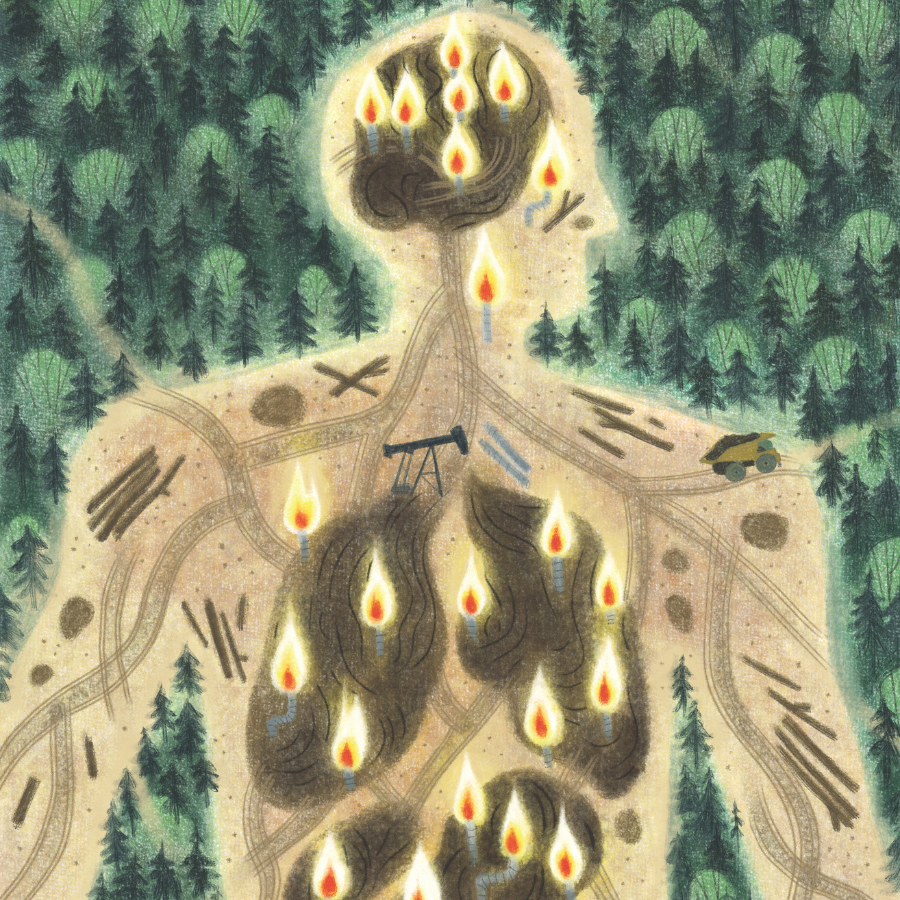
Twenty years after O’Connor first raised concerns, physicians, environmental advocates and community members in Alberta are still calling for more definitive monitoring and investigations into the health and environmental effects of Alberta’s oil and gas industry, not just in Fort Chipewyan but across the province. They say that this kind of research is long overdue and should be initiated now, as Danielle Smith’s government weighs its next steps with what to do with Alberta’s aging oil and gas infrastructure – the old wells, pipes and other dated infrastructure, often referred to as mature assets. Many of these lie in rural regions far from the oil sands and Fort Chipewyan, but also where there is less close monitoring.
The Alberta government published a report last year with recommendations about what to do with the province’s mature assets. The Smith government is expected to take more formal action based on the report later this year. But the report doesn’t call for closer monitoring of non-producing wells – a gap that has industry watchers and community advocates worried.
Amanda Bryant, a climate policy expert and manager of the Pembina Institute’s oil and gas program, says that vital information is being missed. She says the province should be collecting in-depth health and environmental data from all areas with non-producing wells. She wants that information to be collected and made available for analysis. The Alberta Energy Regulator and provincial health authorities do collect data, but not enough, she says. “I would be skeptical that we currently have enough data to be making the judgment that these wells are not posing a health risk. The research that there is shows that there is cause for concern, that there are potential health impacts.”
Better health research is “part of protecting the public, the public interest and the public good,” she adds.
Leaking legacies
Alberta is home to 275,000 marginal, inactive or decommissioned but unreclaimed well bores or surface locations, according to the government’s mature-asset strategy report. Many remain in a state of ambiguity: they no longer produce oil or gas – or else produce so little that they’ve outlived their economic value – but have not been declared inactive, because there’s no economic incentive to do so. Other wells have been decommissioned but have not undergone the required cleanup and restoration to meet the province’s standard.
For years, Alberta has followed the “polluter pays” principle: the party that causes environmental damage is responsible for bearing the costs of cleanup, remediation and compensation. But many companies responsible for abandoned wells have gone out of business. For those wells, the responsibility falls to the Orphan Well Association, a non-profit organization funded by industry levies. Every year, the Alberta Energy Regulator (AER) prescribes the amount for the levy, using a formula to calculate how much each company is required to contribute.
For the 2025/2026 fiscal year, the AER set a levy of $144.45 million. This falls far short of what’s needed for cleanup in Alberta. The Orphan Well Association estimates that the total cost to clean up the sites it manages is $1.12 billion.
In the meantime, wells that are no longer producing but not yet cleaned up remain as they were, and not being as closely monitored as environmental groups would like. The AER maintains public records on location and regulatory status of wells but does not regularly monitor their condition over time. In comparison, active wells undergo regular evaluations for methane leaks and other pollutants, which have been linked to asthma, cancer and cardiovascular issues. Non-producing wells are not without risk. A recent study from researchers at McGill University, published in the journal Environmental Science & Technology, looked at non-producing wells across Canada and found that methane emissions appear to be seven times higher than government estimates.
This doesn’t surprise Paul Belanger, an environmental engineer who worked in the oil and gas industry in Alberta for more than a decade. He is now the science adviser to Keepers of the Water, an Indigenous-led collective formed in 2006 to protect the Arctic Ocean Drainage Basin, the massive land areas whose waterways drain toward the Arctic Ocean. Belanger is concerned by the number of non-producing wells and small pipes throughout Alberta that are not being monitored. “What we’ve got now is abandoned wells in remote areas that look, to me, like they’re going to be ignored forever,” he says. “There’ll never be the money. We don’t have enough whistleblowers or sentinels out there to report every site.”
Belanger believes that saltwater spills at old well sites is an under-recognized threat in Alberta. As wells age, they produce significantly more water than oil, which leads to corrosion and contaminants leaching into the surrounding soil and groundwater. “As we’re sitting here, 30,000 wells are corroding. Rust never sleeps,” Belanger says. “I think that risk is just growing every month.”
The cost of uncertainty
Non-producing wells and the associated health and environmental risks have not been well studied in Canada. There’s fairly limited research into the health effects of oil and gas infrastructure overall. These studies are expensive and time-consuming, require meticulously kept datasets, and are beset with the challenge of distinguishing correlation from cause. On top of that, this is a politically and economically sensitive subject, particularly in Alberta, whose economy depends heavily on the oil and gas industry.
The lack of a strong evidence base is no reason to assume that things are not harmful, says Stephen Wilton, associate professor and cardiologist at the Cumming School of Medicine at the University of Calgary, where he is also co-director for planetary health. “In my mind, there’s enough evidence that we should be concerned,” he says. “One of the principles of public health is this ‘precautionary principle’: if you think there’s enough evidence of some harm and it’s plausible, then you should be taking precautions to avoid it.”
There is some evidence of harm. In one of the most significant studies to date in Canada, a 2021 report published in the journal Frontiers in Oncology showed a significant correlation between living in an area of dense oil and gas infrastructure in Alberta and the incidence of solid tumour cancers. The study is believed to be the first in Canada to look at cancer risk related to both active and inactive wells. The analysis showed that living close to one to three orphan sites was associated with an increased risk of solid tumours. The study showed correlation, not causation – that’s a huge limitation. Even so, the results raise the question of why. The authors concluded that it could be due to a lack of appropriate remediation or not being actively maintained by any proprietor, which could lead to increased environmental contamination.
What we’ve got now is abandoned wells in remote areas that look, to me, like they’re going to be ignored forever. There’ll never be the money. We don’t have enough whistleblowers or sentinels out there to report every site.
— Paul Belanger, environmental engineer
Other studies have shown that Alberta residents who live near oil and gas operations other than non-producing wells experience adverse health outcomes. In one report, published in JAMA Pediatrics in 2020, Calgary researchers found that people who lived within 10 kilometres of at least one fracking site were more likely to have children born small for their gestational age and have major congenital anomalies. In another study published last year, investigators found that 13% of Albertans live within 1.5 kilometres of an active well and 3% within 1.3 kilometres of a flare – and they have a 9% to 21% higher risk of experiencing cardiovascular or respiratory issues than people in the rest of the province. The closer a person lived to an oil or gas well, the greater their risk of these conditions, investigators found.
The study’s lead author is Martin Lavoie, a research scientist and data analyst at FluxLab, a leading methane measurement and technology development group at St. Francis Xavier University in Nova Scotia. Lavoie says that he was surprised by the challenge of getting reliable data on the location of oil and gas wells. “Sometimes the oil and gas industry doesn’t know exactly where is the well,” he says. “So imagine when you try to make the connection between [someone’s health] and a gas well, but you don’t know where is the gas well? Maybe it’s here. Maybe it’s 100 metres further south or west.”
Lavoie says that more accurate data would help researchers make better evaluations of things like methane emissions and health risks. “One of the recommendations to the regulator is just keep better track of what’s going on,” he says. “It’s one thing having the data, which we appreciate very much. But if the data is not accurate or could be more accurate, that’s a different issue.”
So far, most of the research looking at the health and environmental effects of non-producing wells has been done in the United States. In one study published in the journal ACS Omega, researchers reported harmful volatile organic compounds, including the carcinogen benzene, leaking from 48 abandoned wells in Pennsylvania. “In Canada, really surprisingly, we don’t have many studies on health related to the oil and gas industry,” Lavoie says.
Canadian researchers and community advocates want that to change.
In Fort Chipewyan, it is finally starting to change, but only after yet another crisis. In 2022 and 2023, Imperial Oil and the Alberta Energy Regulator failed to let communities know that wastewater containing arsenic, hydrocarbons and other pollutants was seeping into the watershed from Kearl Lake project outside of Fort McMurray.
The following year, the federal government announced nearly $12 million in funding over 10 years for a Fort Chipewyan Health Study. The community-led study, with the Athabasca Chipewyan First Nation, the Mikisew Cree First Nation and the Fort Chipewyan Métis Nation, will examine the impacts of the oil sands on community members’ health. It’s the first large-scale study of this kind in Canada.
Christina Frangou is a long-time health journalist based in Calgary, Alberta.
The Weekly Roundup
Get all our stories in one place, every Wednesday at noon EST.