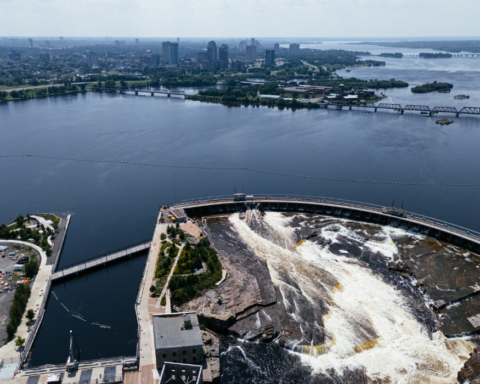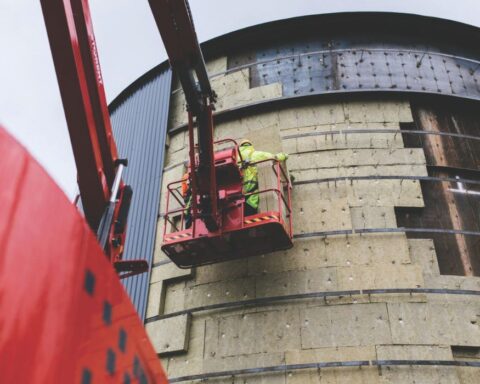

It was an announcement steeped in promise for a world hungry for clean energy. When U.S.-based Air Products and Chemicals revealed plans four years ago for a massive “blue” hydrogen project in Edmonton, officials readied their enthusiasm.
The plant is designed to use Alberta natural gas to produce hydrogen, a clean-burning fuel that is used in refining and could replace oil and gas in a range of applications, including transportation and electricity. Air Products says the plant will capture some 95% of the carbon dioxide it emits and sequester the greenhouse gases in saline aquifer formations deep underground. In short, it was touted as a model for carbon capture and storage (CCS) technology that proponents say can dramatically reduce carbon emissions in the oil and gas sector, as well as in the cement, chemicals and steel industries.
Now, CCS proponents are about to face their biggest test, as Ottawa and Alberta put their weight behind a multibillion-dollar project in the oil sands.
Fading promise
In 2022, both governments were on board for Air Products’ Edmonton blue hydrogen plants. “We need to be bold and seize the moment, and that’s exactly why we’re investing in Air Products,” François-Philippe Champagne, then the industry minister, said in a 2022 news release.
The federal government pitched in $300 million from its strategic innovation fund, alongside Alberta’s $161-million contribution to what was pegged to be a $1.6-billion project. The plant was slated to create 2,500 construction jobs, along with 230 “highly skilled jobs.” Above all, the initiative was billed as “another major step forward on the path to net zero,” the federal government said.
Fast forward three years, and the sheen has faded, amid delays and cost overruns that have doubled the price tag, to US$3.3 billion.
In an investor call last summer, the company labelled the Edmonton operation an “underperforming asset” not expected to be profitable. The plant was originally due to open last summer; projections now put the ribbon-cutting into late 2027, perhaps 2028. Air Products had pinned its hopes on supplying a growing hydrogen market, which so far has failed to materialize.
Keeping the faith
Despite that setback, CCS technology still plays an important role in Canada’s net-zero ambitions and is a key plank in the government’s climate competitiveness strategy unveiled in the November budget. Prime Minister Mark Carney and Energy Minister Tim Hodgson are counting on CCS to deliver emission reductions even as they support expansion on oil and gas infrastructure that will increase exports and production.
On November 27, the prime minister announced an agreement in principle with Alberta Premier Danielle Smith, in which Ottawa will support a bitumen pipeline to the West Coast, in exchange for provincial agreement on a higher carbon price and industry investment in CCS.
Carney has focused on CCS as a key to reducing emissions in the oil and gas sector. The Pathways project will be “the largest carbon capture utilization and storage project in the world,” he said in a speech to the Calgary Chamber of Commerce. “It will make Alberta oil amongst the lowest carbon intensity in the world, and it has the potential to create an entirely new industry in Canada.”
At the same time, proponents are touting CCS as a key means of cutting emissions in industrial sectors like cement and steel.
Despite the ongoing enthusiasm in Ottawa, the Air Products failure serves as a warning to the Liberal government and other would-be investors. Scaling up CCS will require huge subsidies. Just how much investment risk corporations will take on it remains up in the air. And in Canada, the tension between climate policy and a powerful petroleum sector is on full display, adding another layer of uncertainty.
Environmental groups argue that CCS is being used as a panacea to justify continued production and use of oil and gas, which will make it harder and more costly to deal with climate change in the coming decades. The majority of emissions from a barrel of oil, after all, come from its combustion in cars, planes, ships and other end uses.
“The narrative around so-called decarbonizing oil is nothing but a myth to justify expansion of oil production,” says Aly Hyder Ali, oil and gas manager at the Canadian advocacy group Environmental Defence.
An expensive proposition
Canada is not alone in pursuing CCS. It remains an important component in decarbonization strategies produced by groups like the International Energy Agency and the United Nations’ Intergovernmental Panel on Climate Change. To date, there are 77 commercial projects in operation globally capturing up to 64 million tonnes of carbon dioxide per year, with 47 more under construction. However, few of those target oil production facilities like Canada’s oil sands. Norway’s Sleipner project, for example, is the world’s first commercial CCS facility and is located in an offshore natural gas field.
Norway-based consulting firm DNV Group anticipates the world will spend some US$80 billion on CCS projects between now and 2030. Much of that investment will be focused on natural gas processing and cement and steel producers, DNV said in a report released last summer.
But there remain huge hurdles to investment. In addition to prohibitive capital costs, CCS drives up operating costs at existing plants and can be energy intensive.
In search of profitability
Canada’s cement industry has focused on CCS as part of its plan to be net-zero by 2050. To date, however, no company has made an investment in a CCS facility. “The only way to make this work is if there is a path to profitability,” says Sarah Petrevan, vice president for industrial decarbonization at the Cement Association of Canada. “And there is no path to profitability.”
To help make CCS financially viable, Carney’s first budget seeks to increase the industrial carbon tax and make it apply to a greater percentage of a company’s emissions. The levy applies to a portion of emissions from the country’s largest polluters. It now costs $95 per tonne of carbon dioxide and is due to rise.
A more costly carbon tax is intended to incentivize businesses to invest in multibillion-dollar emission-reduction projects, like CCS. Ottawa is also providing companies with a type of insurance, known as contracts for differences, which compensates investors if carbon prices fall below project costs.


The industrial carbon price “plays a big role in determining the economic viability of various low-carbon projects,” Dale Beugin, research director for the Canadian Climate Institute, wrote in an explainer. “But the risk of future governments moving away from that carbon pricing pathway dilutes the policy certainty – and the incentive to invest in clean growth projects.”
However, the levy won’t work to drive investment unless it has greater stringency and applies to a greater percentage of a plant’s emissions, Beugin argues.
The Alberta showdown
After the budget’s release, Petrevan welcomed the government’s climate-competitiveness pledges. She hedged, however, on whether the budget measures would provide a “path to profitability” for CCS projects. “Stability and predictability of the industrial carbon price are important contributors to building a positive business case for investment.”
However, the federal government will have to find “alignment” with the provinces, Petrevan says. (Ottawa sets benchmarks for the industrial levy, but most provinces administer their own systems.) Alberta – home to the vast oil-sands sector – froze the price at $95 earlier this year. More recently, it proposed to allow a broader range of investments to count toward a company’s compliance requirements and allowed smaller firms to opt out completely.
The changes would reduce demand for the credits that companies receive when they succeed in reducing emissions. Cheaper credits would result in lower return on investment, and therefore less spending on emission-reduction technology.
The federal–Alberta memorandum signed in November commits the two sides to working together to “design and commit to globally competitive long-term carbon effective prices.” Alberta agreed to unfreeze the price to rise to $130 over the next three years.
The carbon price still won’t be enough to drive investment in CCS, says Chris Bataille, a Vancouver-based fellow with Columbia University’s Center on Global Energy Policy. With the enforcement mechanism related to pipeline progress, “it has to become basically a regulatory outcome,” he says. “That doesn’t mean post-combustion CCS will work or that the feds will enforce the deal. But Alberta gets to push forward its pipeline.”
Oil-sands companies working together under an umbrella organization dubbed the Pathways Alliance have released their own plan for emission reductions that relies on heavily subsidized CCS and a strong carbon credit market.
The federal–provincial memorandum endorses the industry plan, and Ottawa and Alberta pledge to work with the oil companies in advancing the plan, with construction starting by 2027.
Corporate investment in CCS is contingent on the approval, commencement and continued construction of the pipeline, while ongoing progress with the pipeline will be contingent on the Pathways plan moving ahead. The federal government also agreed to drop its proposed cap on emissions from the oil and gas sector.
Bataille argues that Ottawa needs the threat of a cap as a stick. “Without the emissions cap as leverage – get these [emissions] cuts done or we will do this – I don’t see it happening,” he says.
A subsidized market
It’s clear that without government intervention, carbon capture will not take root. The Pathways Alliance has laid out a $16.5-billion CCS plan that would require significant tax breaks. Even with those subsidies, it’s questionable how many carbon-capture projects would be built given the long-term financial risks and technological issues.
A key problem is that government policy is by its nature uncertain, especially given that Carney presides over a minority government that has a precarious hold on power. Any promise by Ottawa to set a floor under the cost of emitting and guarantee profitability for CCS could be quickly undone by a new federal government that would share Alberta’s opposition to aggressive climate action. Conservative Leader Pierre Poilievre – who came within 25 seats of winning the March election – has shown little enthusiasm for climate policy and promised to unshackle the oil and gas industry.
In the United States, President Donald Trump has scuttled virtually all the climate measures adopted under Joe Biden.
Given those risks, corporate CEOs will be reluctant to invest in CCS projects that are bolted onto existing production facilities and generate no revenue except through regulatory means, Bataille says. The promise of a pipeline may, however, be the carrot that drives action.
Momentum continues
Carbon capture itself isn’t novel, but its application for large-scale underground storage remains unproven over the long term.
The fossil fuel industry already captures carbon dioxide for natural gas processing plants and injects the gas into old wells to enhance oil production. The Pathways plan would largely sequester carbon in saline aquifers rather than sell it. Worldwide, there is much less space underground for injected carbon than previously thought: less than a fifth of what the Intergovernmental Panel on Climate Change has estimated, according to a recent study by researchers at Imperial College London.
Carbon capture also isn’t widely applicable. In upstream oil-sands production, a large percentage of emissions result from burning natural gas in boilers to produce steam needed to extract bitumen, and from burning diesel in large trucks and other machinery. CCS would not currently be viable for either of those sources.
Sean McCoy, a professor at the Schulich School of Engineering at the University of Calgary, estimates that roughly 60% of carbon emissions in the oil-sands sector “might be capturable” with CCS. Despite the challenges, CCS continues to find support from government, even as the list of cancelled projects grows longer. Just last year, Edmonton-based Capital Power pulled the plug on a proposed $2.4-billion CCS project at its Genesee gas-fired generating station. “Through our development of the project, we have confirmed that CCS is a technically viable technology,” the company said in its statement. “However, at this time, the project is not economically feasible.”
The reality gap
Among the projects that have materialized, there is also a gap between carbon-capture promise and reality. A recent report from the Institute for Energy Economics and Financial Analysis (IEEFA) noted that claims of capture rates of 90% or more are misleading. Typically, the promise of higher capture rates applies only to concentrated streams of emissions at the specific types of plants.
In the oil and gas industry, CCS is used for natural gas processing plants that purify the fuel by removing contaminants like water, carbon dioxide, hydrogen sulphides and solids. And it includes facilities that produce hydrogen from gas for use in oil-sands upgraders and refineries.
Even at natural gas processing and hydrogen plants, carbon-capture rates rarely exceed 70% of emissions, the IEEFA report said.
Some projects, including at Air Products in Edmonton, are employing a new technology to produce hydrogen: autothermal reforming, which replaces steam methane reforming. Autothermal reforming is both more energy efficient and more capital intensive than the steam methane process. It also creates a more concentrated emission stream.
CCS is best suited for applications that have high carbon dioxide concentrations in their flue gas and have high and stable flow emissions. In other words, facilities that burn hot and steady.
Even in the bullish forecast by Norway’s DNV Group, CCS would capture only 6% of global emissions in 2050, a level that falls well short of what the consultancy says is needed to achieve any net-zero outcome.
“Recent turmoil, and budgetary pressure in the global economy pose risks to CCS deployment, potentially shifting priorities and removing the necessary finance,” the DNV authors wrote.
While some CCS will be viable, overly optimistic reliance on CCS is a trap if it is used to support delays in other emission-reduction strategies. The more we delay the transition away from fossil fuels, the more we will have to rely on hugely expensive carbon-capture strategies.
Shawn McCarthy is an Ottawa-based writer and senior counsel with Sussex Strategy Group.
The Weekly Roundup
Get all our stories in one place, every Wednesday at noon EST.